Linear group
General linear group and representation theory[edit]


Matrix groups consist of matrices together with matrix multiplication. The general linear group consists of all invertible -by- matrices with real entries.[61] Its subgroups are referred to as matrix groups or linear groups. The dihedral group example mentioned above can be viewed as a (very small) matrix group. Another important matrix group is the special orthogonal group . It describes all possible rotations in dimensions. Rotation matrices in this group are used in computer graphics.[62]


Representation theory is both an application of the group concept and important for a deeper understanding of groups.[63][64] It studies the group by its group actions on other spaces. A broad class of group representations are linear representations in which the group acts on a vector space, such as the three-dimensional Euclidean space . A representation of a group on an -dimensional real vector space is simply a group homomorphism from the group to the general linear group. This way, the group operation, which may be abstractly given, translates to the multiplication of matrices making it accessible to explicit computations.[r]



A group action gives further means to study the object being acted on.[s] On the other hand, it also yields information about the group. Group representations are an organizing principle in the theory of finite groups, Lie groups, algebraic groups and topological groups, especially (locally) compact groups.[63][65]
Galois groups[edit]
Galois groups were developed to help solve polynomial equations by capturing their symmetry features.[66][67] For example, the solutions of the quadratic equation are given by

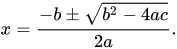


Modern Galois theory generalizes the above type of Galois groups by shifting to field theory and considering field extensions formed as the splitting field of a polynomial. This theory establishes—via the fundamental theorem of Galois theory—a precise relationship between fields and groups, underlining once again the ubiquity of groups in mathematics.[70]
Finite groups[edit]
A group is called finite if it has a finite number of elements. The number of elements is called the order of the group.[71] An important class is the symmetric groups , the groups of permutations of objects. For example, the symmetric group on 3 letters is the group of all possible reorderings of the objects. The three letters ABC can be reordered into ABC, ACB, BAC, BCA, CAB, CBA, forming in total 6 (factorial of 3) elements. The group operation is composition of these reorderings, and the identity element is the reordering operation that leaves the order unchanged. This class is fundamental insofar as any finite group can be expressed as a subgroup of a symmetric group for a suitable integer , according to Cayley's theorem. Parallel to the group of symmetries of the square above, can also be interpreted as the group of symmetries of an equilateral triangle.


The order of an element in a group is the least positive integer such that , where represents


More sophisticated counting techniques, for example, counting cosets, yield more precise statements about finite groups: Lagrange's Theorem states that for a finite group the order of any finite subgroup divides the order of . The Sylow theorems give a partial converse.

The dihedral group of symmetries of a square is a finite group of order 8. In this group, the order of is 4, as is the order of the subgroup that this element generates. The order of the reflection elements etc. is 2. Both orders divide 8, as predicted by Lagrange's theorem. The groups of multiplication modulo a prime have order .


Comments
Post a Comment