Probability theory
Like other theories, the theory of probability is a representation of its concepts in formal terms—that is, in terms that can be considered separately from their meaning. These formal terms are manipulated by the rules of mathematics and logic, and any results are interpreted or translated back into the problem domain.
There have been at least two successful attempts to formalize probability, namely the Kolmogorov formulation and the Cox formulation. In Kolmogorov's formulation (see also probability space), sets are interpreted as events and probability as a measure on a class of sets. In Cox's theorem, probability is taken as a primitive (i.e., not further analyzed), and the emphasis is on constructing a consistent assignment of probability values to propositions. In both cases, the laws of probability are the same, except for technical details.
There are other methods for quantifying uncertainty, such as the Dempster–Shafer theory or possibility theory, but those are essentially different and not compatible with the usually-understood laws of probability.
Applications[edit]
Probability theory is applied in everyday life in risk assessment and modeling. The insurance industry and markets use actuarial science to determine pricing and make trading decisions. Governments apply probabilistic methods in environmental regulation, entitlement analysis, and financial regulation.
An example of the use of probability theory in equity trading is the effect of the perceived probability of any widespread Middle East conflict on oil prices, which have ripple effects in the economy as a whole. An assessment by a commodity trader that a war is more likely can send that commodity's prices up or down, and signals other traders of that opinion. Accordingly, the probabilities are neither assessed independently nor necessarily rationally. The theory of behavioral finance emerged to describe the effect of such groupthink on pricing, on policy, and on peace and conflict.[24]
In addition to financial assessment, probability can be used to analyze trends in biology (e.g., disease spread) as well as ecology (e.g., biological Punnett squares). As with finance, risk assessment can be used as a statistical tool to calculate the likelihood of undesirable events occurring, and can assist with implementing protocols to avoid encountering such circumstances. Probability is used to design games of chance so that casinos can make a guaranteed profit, yet provide payouts to players that are frequent enough to encourage continued play.[25]
Another significant application of probability theory in everyday life is reliability. Many consumer products, such as automobiles and consumer electronics, use reliability theory in product design to reduce the probability of failure. Failure probability may influence a manufacturer's decisions on a product's warranty.[26]
The cache language model and other statistical language models that are used in natural language processing are also examples of applications of probability theory.
Mathematical treatment[edit]

Consider an experiment that can produce a number of results. The collection of all possible results is called the sample space of the experiment, sometimes denoted as . The power set of the sample space is formed by considering all different collections of possible results. For example, rolling a die can produce six possible results. One collection of possible results gives an odd number on the die. Thus, the subset {1,3,5} is an element of the power set of the sample space of dice rolls. These collections are called "events". In this case, {1,3,5} is the event that the die falls on some odd number. If the results that actually occur fall in a given event, the event is said to have occurred.

A probability is a way of assigning every event a value between zero and one, with the requirement that the event made up of all possible results (in our example, the event {1,2,3,4,5,6}) is assigned a value of one. To qualify as a probability, the assignment of values must satisfy the requirement that for any collection of mutually exclusive events (events with no common results, such as the events {1,6}, {3}, and {2,4}), the probability that at least one of the events will occur is given by the sum of the probabilities of all the individual events.[27]
The probability of an event A is written as ,[28] , or .[29] This mathematical definition of probability can extend to infinite sample spaces, and even uncountable sample spaces, using the concept of a measure.


The opposite or complement of an event A is the event [not A] (that is, the event of A not occurring), often denoted as , , or ; its probability is given by P(not A) = 1 − P(A).[30] As an example, the chance of not rolling a six on a six-sided die is 1 – (chance of rolling a six) . For a more comprehensive treatment, see Complementary event.


If two events A and B occur on a single performance of an experiment, this is called the intersection or joint probability of A and B, denoted as .

Independent events[edit]
If two events, A and B are independent then the joint probability is[28]

For example, if two coins are flipped, then the chance of both being heads is .[31]

Mutually exclusive events[edit]
If either event A or event B can occur but never both simultaneously, then they are called mutually exclusive events.
If two events are mutually exclusive, then the probability of both occurring is denoted as and

If two events are mutually exclusive, then the probability of either occurring is denoted as and


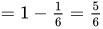
For example, the chance of rolling a 1 or 2 on a six-sided die is

Not mutually exclusive events[edit]
If the events are not mutually exclusive then

For example, when drawing a card from a deck of cards, the chance of getting a heart or a face card (J,Q,K) (or both) is , since among the 52 cards of a deck, 13 are hearts, 12 are face cards, and 3 are both: here the possibilities included in the "3 that are both" are included in each of the "13 hearts" and the "12 face cards", but should only be counted once.

Conditional probability[edit]
Conditional probability is the probability of some event A, given the occurrence of some other event B. Conditional probability is written , and is read "the probability of A, given B". It is defined by[32]

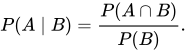
If then is formally undefined by this expression. In this case and are independent, since . However, it is possible to define a conditional probability for some zero-probability events using a σ-algebra of such events (such as those arising from a continuous random variable).[33]



For example, in a bag of 2 red balls and 2 blue balls (4 balls in total), the probability of taking a red ball is ; however, when taking a second ball, the probability of it being either a red ball or a blue ball depends on the ball previously taken. For example, if a red ball was taken, then the probability of picking a red ball again would be , since only 1 red and 2 blue balls would have been remaining. And if a blue ball was taken previously, the probability of taking a red ball will be .


Comments
Post a Comment