LINEAR EQUATIONS
Linear equations[edit]
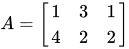
Systems of homogeneous linear equations are closely tied to vector spaces.[14] For example, the solutions of
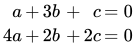


where is the matrix containing the coefficients of the given equations, is the vector denotes the matrix product, and is the zero vector. In a similar vein, the solutions of homogeneous linear differential equations form vector spaces. For example,



yields where and are arbitrary constants, and is the natural exponential function.



Linear maps and matrices[edit]
The relation of two vector spaces can be expressed by linear map or linear transformation. They are functions that reflect the vector space structure, that is, they preserve sums and scalar multiplication:




An isomorphism is a linear map f : V → W such that there exists an inverse map g : W → V, which is a map such that the two possible compositions f ∘ g : W → W and g ∘ f : V → V are identity maps. Equivalently, f is both one-to-one (injective) and onto (surjective).[16] If there exists an isomorphism between V and W, the two spaces are said to be isomorphic; they are then essentially identical as vector spaces, since all identities holding in V are, via f, transported to similar ones in W, and vice versa via g.

For example, the "arrows in the plane" and "ordered pairs of numbers" vector spaces in the introduction are isomorphic: a planar arrow v departing at the origin of some (fixed) coordinate system can be expressed as an ordered pair by considering the x- and y-component of the arrow, as shown in the image at the right. Conversely, given a pair (x, y), the arrow going by x to the right (or to the left, if x is negative), and y up (down, if y is negative) turns back the arrow v.
Linear maps V → W between two vector spaces form a vector space HomF(V, W), also denoted L(V, W), or 𝓛(V, W).[17] The space of linear maps from V to F is called the dual vector space, denoted V∗.[18] Via the injective natural map V → V∗∗, any vector space can be embedded into its bidual; the map is an isomorphism if and only if the space is finite-dimensional.[19]
Once a basis of V is chosen, linear maps f : V → W are completely determined by specifying the images of the basis vectors, because any element of V is expressed uniquely as a linear combination of them.[20] If dim V = dim W, a 1-to-1 correspondence between fixed bases of V and W gives rise to a linear map that maps any basis element of V to the corresponding basis element of W. It is an isomorphism, by its very definition.[21] Therefore, two vector spaces over a given field are isomorphic if their dimensions agree and vice versa. Another way to express this is that any vector space over a given field is completely classified (up to isomorphism) by its dimension, a single number. In particular, any n-dimensional F-vector space V is isomorphic to Fn. There is, however, no "canonical" or preferred isomorphism; actually an isomorphism φ : Fn → V is equivalent to the choice of a basis of V, by mapping the standard basis of Fn to V, via φ. The freedom of choosing a convenient basis is particularly useful in the infinite-dimensional context; see below


Comments
Post a Comment