Equation order and degree
Equation order and degree[edit]
The order of the differential equation is the order of the highest derivative of the unknown function that appears in it. When a differential equation is written as a polynomial equation in the unknown function and its derivatives, its degree is, depending on the context, the degree in the highest derivative of the unknown function,[12] or its total degree in the unknown function and its derivatives. In particular, a linear differential equation has degree one for both meanings, but the non-linear differential equation is of degree one for the first meaning but not for the second one.

An equation containing only first derivatives is a first-order differential equation, an equation containing the second derivative is a second-order differential equation, and so on.[13][14]
Differential equations that describe natural phenomena almost always have only first and second order derivatives in them, but there are some exceptions, such as the thin-film equation, which is a fourth order partial differential equation.
Examples[edit]
In the first group of examples u is an unknown function of x, and c and ω are constants that are supposed to be known. Two broad classifications of both ordinary and partial differential equations consist of distinguishing between linear and nonlinear differential equations, and between homogeneous differential equations and heterogeneous ones.
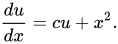
- Heterogeneous first-order linear constant coefficient ordinary differential equation:
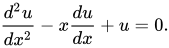
- Homogeneous second-order linear ordinary differential equation:
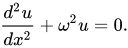
- Homogeneous second-order linear constant coefficient ordinary differential equation describing the harmonic oscillator:
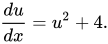
- Heterogeneous first-order nonlinear ordinary differential equation:
- Second-order nonlinear (due to sine function) ordinary differential equation describing the motion of a pendulum of length L:
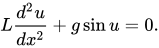
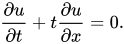
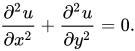
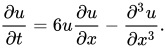
In the next group of examples, the unknown function u depends on two variables x and t or x and y.
- Homogeneous first-order linear partial differential equation:
- Homogeneous second-order linear constant coefficient partial differential equation of elliptic type, the Laplace equation:
- Homogeneous third-order non-linear partial differential equation, the KdV equation:
Existence of solutions[edit]
Solving differential equations is not like solving algebraic equations. Not only are their solutions often unclear, but whether solutions are unique or exist at all are also notable subjects of interest.
For first order initial value problems, the Peano existence theorem gives one set of circumstances in which a solution exists. Given any point in the xy-plane, define some rectangular region , such that and is in the interior of . If we are given a differential equation and the condition that when , then there is locally a solution to this problem if and are both continuous on . This solution exists on some interval with its center at . The solution may not be unique. (See Ordinary differential equation for other results.)


![{\displaystyle Z=[l,m]\times [n,p]}](https://wikimedia.org/api/rest_v1/media/math/render/svg/515b71ad3b5fc01ff532df8cb71018baca811973)


However, this only helps us with first order initial value problems. Suppose we had a linear initial value problem of the nth order:

such that

For any nonzero , if and are continuous on some interval containing , is unique and exists.[15]


Comments
Post a Comment